
What Chamath Palihapitiya’s 30 Years in Business Reveal About Optionality and Leadership
This article is part of The Thought Stack, a flagship editorial series by Starlabs Consulting dedicated to leadership research and strategic insights in the age of disruptive global technologies.
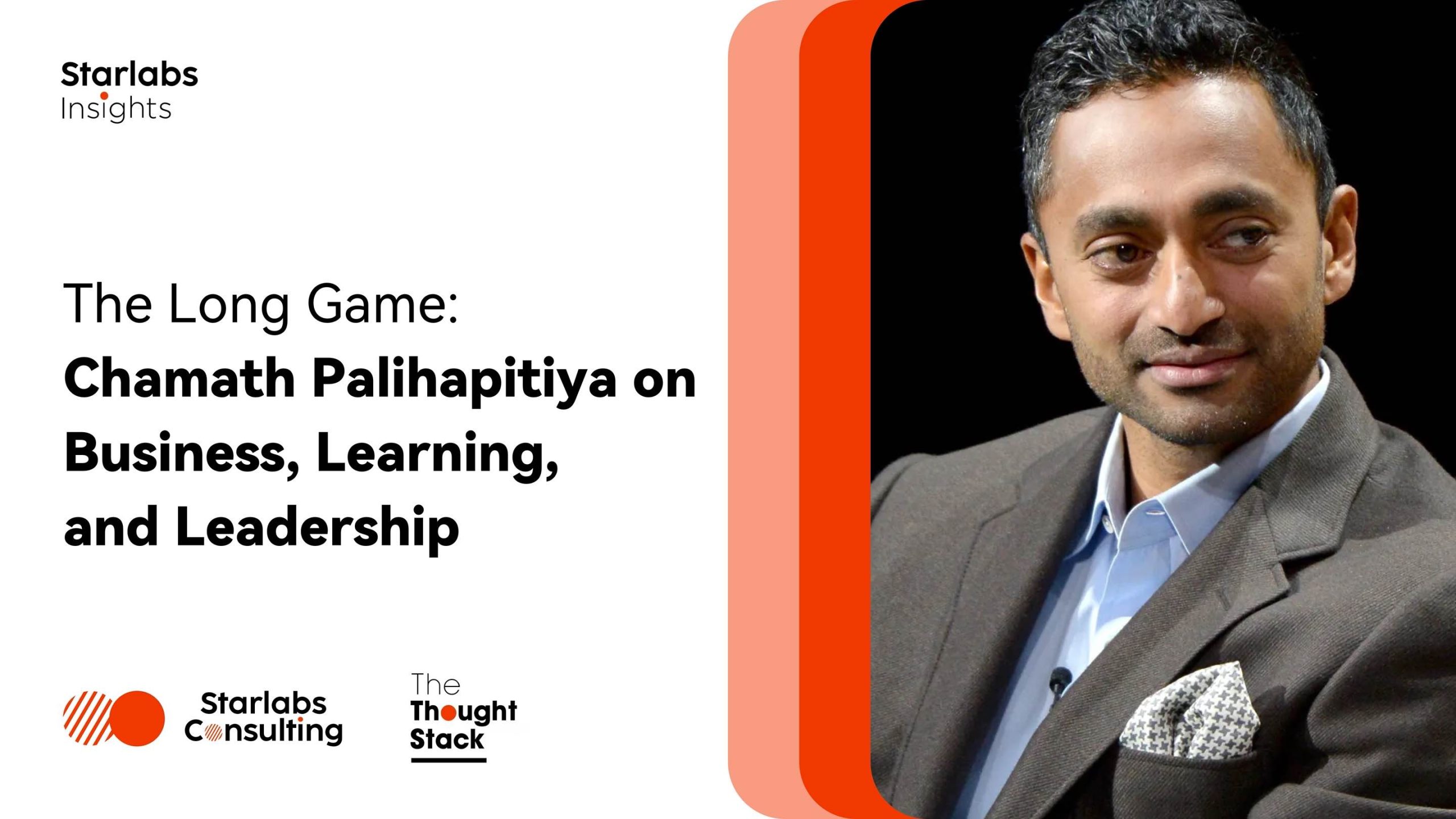
In a short but insightful 13-minute talk, venture capitalist and Social Capital founder Chamath Palihapitiya distilled three decades of experience in business, investing, and life into a set of practical lessons.
Chamath is best known as an early executive at Facebook and later as a prominent Silicon Valley investor. Over the years, he has built companies, invested in transformative technologies, and navigated multiple cycles of the tech industry.
Looking back on his career, his biggest realization is surprisingly simple:
“You can just never stop.”
According to Chamath, one of the biggest mistakes people make is structuring their lives around predefined objectives.
“People frame their life as these objectives. And the problem with having objectives is that at some point you’ll meet enough of them and you’ll think: I’ve made it.”
Instead, he argues that the most fulfilling and resilient careers are built not around milestones, but around a continuous process of learning, exploration, and risk-taking.
Below are several key ideas from his reflection on 30 years in business.
1. Focus on the Process, Not Just the Goal
Many professionals approach their careers as a checklist:
- Get promoted
- Reach a certain title
- Earn a specific income
- Achieve financial independence
While these goals can be motivating, Chamath believes they can also become limiting.
Once people achieve enough of these milestones, they often feel they have “arrived,” and their curiosity and ambition begin to fade.
In contrast, some of the most remarkable figures in business remain deeply engaged throughout their lives.
“Look at someone like Buffett — he just keeps going.”
The difference, Chamath suggests, is that these individuals are not chasing a specific endpoint. They are committed to learning, staying intellectually active, and constantly evolving.
2. Avoid Debt to Preserve Freedom
One of the most practical pieces of advice Chamath offers is simple:
“You cannot have debt. Debt is one of these things that will cause you to stop.”
Debt, he explains, often forces people into short-term decisions. It reduces the ability to take risks, explore new opportunities, or pivot professionally.
When individuals are financially constrained, they may prioritize stability over growth, which can shape the trajectory of their lives for decades.
Avoiding excessive debt is therefore not just a financial strategy—it is a way to preserve long-term optionality.
3. Manage Your Life with Humility
Another lesson Chamath highlights is the importance of intellectual honesty and humility.
“You need to manage your life with humility.”
This means being truthful about reality—about what is working, what is failing, and what still needs to be learned.
Humility allows individuals to see problems more clearly and to build stronger relationships with colleagues, partners, and collaborators. In the long run, authenticity often proves more valuable than confidence alone.
4. Learn from Younger Generations
As experience accumulates, professionals often rely heavily on frameworks developed earlier in their careers. However, Chamath believes this can become a liability.
“Young people are like an early warning system for the future.”
Younger generations often view technology, culture, and markets through entirely different lenses. Their assumptions and mental models reflect the world that is emerging rather than the one that existed a decade earlier.
Surrounding yourself with younger talent can therefore help prevent your thinking from becoming outdated.
5. Preserve Optionality
One concept Chamath repeatedly emphasizes is optionality—the ability to maintain flexibility in decisions and future paths.
“Preserve optionality at all costs.”
In business negotiations, career decisions, and partnerships, maintaining optionality allows individuals to adapt as circumstances change.
It also encourages solutions that create mutual benefit, rather than forcing rigid outcomes that damage long-term relationships.
Over time, this mindset can lead to more durable networks and opportunities.
6. Build Relationships Based on Radical Honesty
Chamath also reflects on lessons learned in personal relationships, particularly marriage and long-term partnerships.
“The most important relationship lesson I’ve learned is that you need to be married to somebody that 100% has your back.”
But such trust is only possible through complete honesty.
“What was missing was complete honesty.”
Without transparency, problems often remain hidden until they become impossible to ignore. Whether in personal life or business partnerships, sustained success depends on trust and open communication.
7. Be Where the Opportunities Are
For young professionals especially, location still matters.
“You have to be where the fish are.”
Every industry has geographic centers where networks, talent, and opportunities concentrate.
Historically, for example:
- Technology → Silicon Valley
- Finance → New York or London
- Politics → Washington, D.C.
Being in the right ecosystem dramatically increases the chances of encountering transformative opportunities.
8. Optimize for Opportunity, Not Compensation
Chamath believes that early career decisions should prioritize learning and opportunity rather than salary.
“You should not be optimizing for compensation. You should optimize for opportunity.”
Working with exceptional people on high-potential projects can accelerate learning in ways that compensation alone cannot.
Over the long term, these experiences often lead to far greater outcomes.
9. Human Potential Is Greater Than We Think
Chamath illustrates human resilience with a striking analogy involving a scientific experiment.
In the experiment, mice placed in water would typically drown within minutes. But if rescued briefly and then returned to the water, they could survive for dramatically longer periods.
The implication is that belief and experience can unlock hidden reserves of endurance.
In business and entrepreneurship, similar breakthroughs often occur when individuals push beyond perceived limits.
10. Status Is Often an Illusion
Finally, Chamath warns against chasing social status.
“Status is completely manufactured and irrelevant.”
Many markers of prestige—exclusive clubs, rankings, titles—are ultimately social constructs.
When individuals pursue them too aggressively, they risk allowing external validation to shape their decisions.
True independence, Chamath suggests, comes from focusing on meaningful work rather than symbolic recognition.
A Long Game Without an Endpoint
After three decades in business, Chamath’s core philosophy can be summarized in a single idea:
“Give yourself complete optionality.”
Careers, like markets, are dynamic systems. The individuals who thrive over long time horizons are often those who maintain flexibility, curiosity, and resilience.
Rather than treating success as a fixed destination, Chamath encourages people to see it as an ongoing process of learning and adaptation.
In that sense, the most successful careers are not defined by when someone stops—but by how long they remain in the arena.
Source Note
This article synthesizes insights from a public talk by venture capitalist Chamath Palihapitiya titled “30 Years of Business Advice in 13 Minutes”, published on YouTube.
About “The Thought Stack”
The Thought Stack is a flagship editorial series by Starlabs Consulting, dedicated to leadership research and insights in the realm of disruptive global technologies. Rooted in a global perspective and strategic consulting practice, the series aims to deliver forward-looking, actionable leadership frameworks that enable organizations to navigate transformation, drive sustainable growth, and create long-term value.