
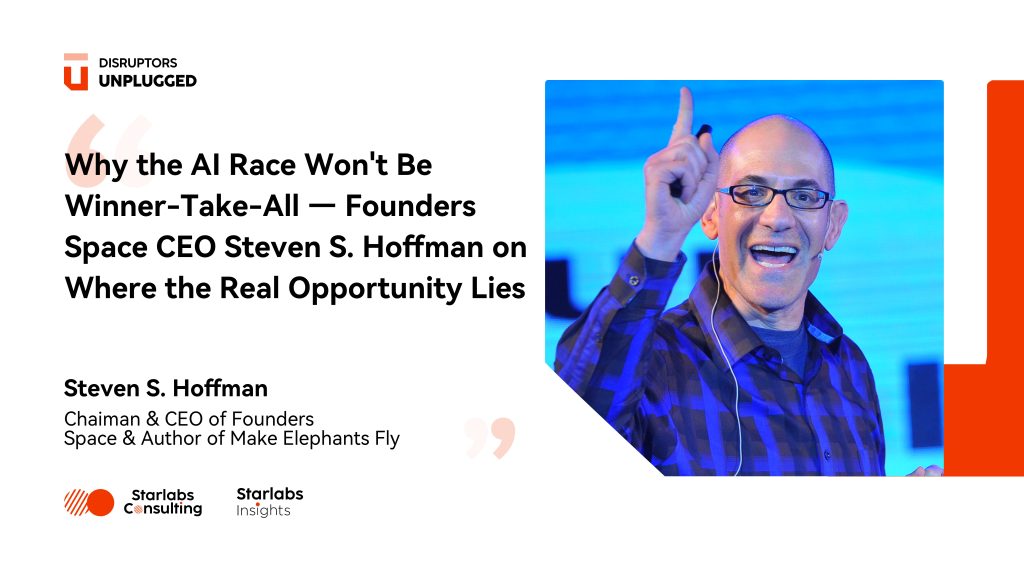
Why the AI Race Won’t Be Winner-Take-All — Founders Space CEO Steven S. Hoffman on Where the Real Opportunity Lies
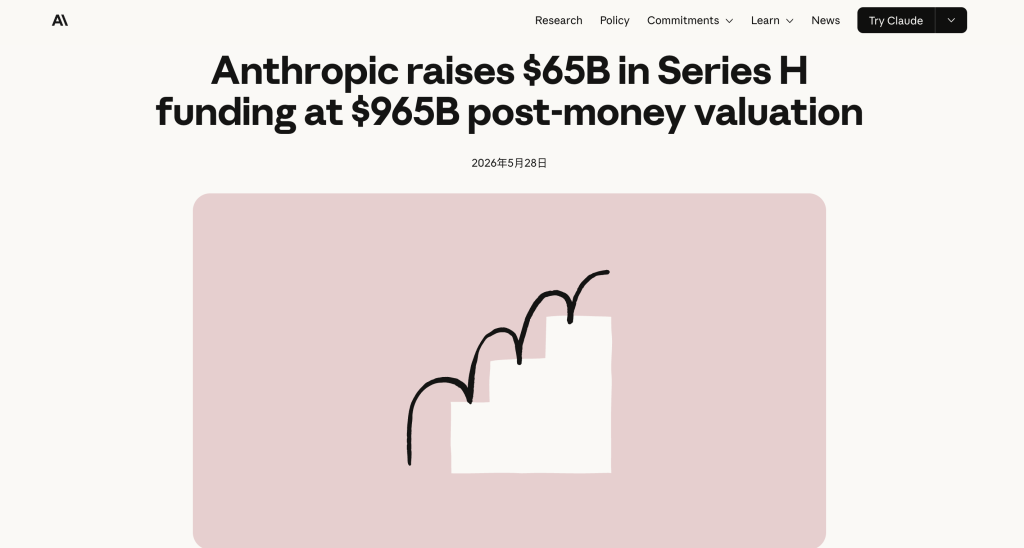
On May 28, Anthropic — the company behind Claude — closed a $65 billion funding round, pushing its valuation to $965 billion and overtaking OpenAI ($852 billion) to become the world’s most valuable private AI company — nearly a trillion dollars for a company that is still, by any traditional measure, a research lab.
This is the world early-stage AI founders are navigating: one where capital is abundant, hype is deafening, and big tech can ship a competing product faster than most startups can close a seed round. Where does that leave everyone else?
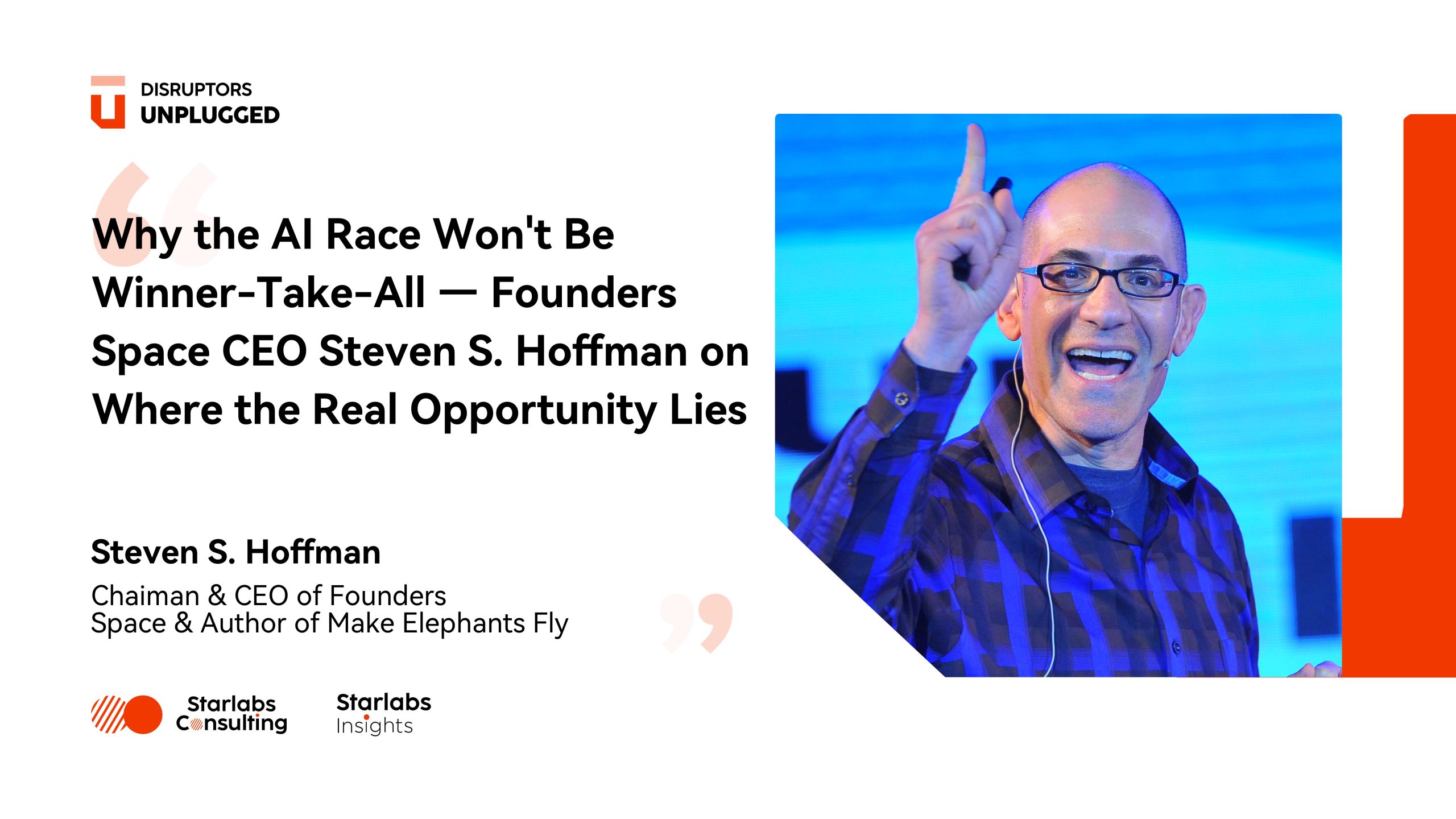
Few people are better positioned to answer that question than Steven S. Hoffman. Known as “Captain Hoff,” he is the Chairman and CEO of Founders Space — one of the world’s leading startup accelerators — and the author of “Make Elephants Fly”, “Surviving a Startup”, and “The Five Forces of Innovation”. A serial entrepreneur and venture investor, Hoffman has guided thousands of startups across Silicon Valley and beyond through technology cycles that have humbled far larger institutions than most founders will ever build.
His view on the current moment: the AI race is real, the stakes are high — and most of the conventional wisdom about who wins and why is wrong.
Starlabs Consulting founder and CEO Jenny Yang interviewed Steven S.Hoffman on China’s AI edge, the fate of knowledge workers, and what it actually takes to build a defensible company when the infrastructure beneath you is shifting every six months.
The following is an edited transcript of their conversation.
Jenny Yang: You’re in China right now. What’s your assessment of China’s AI ecosystem — and how do you see the Silicon Valley-China dynamic unfolding from here?
Steven S. Hoffman: My impression is that China is moving fast. Extremely fast. The startups I’m talking to are integrating AI into everything: payments, logistics, customer service, HR, marketing, sales, procurement, manufacturing, and more.
At the same time, I believe Silicon Valley will continue to dominate frontier model research. The concentration of compute, talent, and capital in the US is still unmatched. But China will win on deployment. Chinese companies are extraordinarily good at taking a technology and scaling it into a real product with real users at incredible speed. This discipline and the obsession with execution is China’s strength.
China also has strong AI labs, including Moonshot, Alibaba, Bytedance, and DeepSeek. These AI labs will continue as fast followers, right behind their US counterparts. What China’s labs lack in capital, they make up for in innovative ways to keep costs down while scaling their platforms globally.
China also dominates in robotics. There is no place on Earth with the supply chain, infrastructure, and talent necessary to scale robot production. The next phase of the AI race is not winner-take-all. Silicon Valley will continue building the most powerful engines, while China will build the best hardware and businesses. Both matter.
Jenny Yang: Does AI have borders? Given the pace of regulatory change — data sovereignty, national security reviews, export restrictions — where do you come down on local-first versus global-from-day-one?
Steven S. Hoffman: AI technically has no borders. But regulation is drawing them fast.
Data sovereignty laws, national security reviews, model export restrictions are reshaping the legal landscape. Some founders see this and conclude they should go deep in one market. I understand the logic. I just don’t agree with it.
I favor Global from Day 1. Here’s why.
The companies that built locally and planned to expand later almost always struggle. Distribution channels are different. Compliance requirements diverge. Brand positioning has to be rebuilt from scratch. It’s expensive and slow.
Global-first companies build systems that are modular and adaptable from the beginning. They architect for regulatory variance rather than retrofitting for it. They attract diverse teams who understand multiple markets. That gives them a durable structural advantage.
Yes, governance is getting harder. Yes, companies will need local compliance layers. But the solution is smart architecture, not retreating into one geography. The market opportunity is global. Every tech entrepreneur’s ambitions should be too.
Jenny Yang: You’ve argued that we’re still in the earliest stages of the AI revolution, and that the rise of autonomous agents will fundamentally reshape how businesses operate. How close are we to that tipping point — and how should companies and institutions be positioning themselves ahead of the displacement that follows?
Steven S. Hoffman: We are close. Closer than most people think, and further than the hype suggests.
Autonomous agents that can handle discrete, well-defined tasks are already here. Customer support. Code review. Data analysis. Research synthesis. These are not demos. They are in production.
The inflection point — where agents can truly coordinate with each other, handle ambiguous multi-step goals, and operate across systems without human supervision — is probably two to four years away. Maybe sooner.
When that hits, the displacement will be real. Not theoretical. Real.
On the business model side, the smartest founders are designing for human-AI collaboration rather than pure automation. They are creating roles where humans provide judgment, creativity, and accountability, while agents handle volume and speed. That is a more resilient model, and it’s better for your workforce.
On the policy side, we need honest conversations about retraining, social safety nets, and education reform. The jobs being displaced are not low-skill jobs. They include lawyers, analysts, writers, consultants, and practically every other type of knowledge work. That changes the political calculus entirely.
The answer is not to slow AI. It’s to move our institutions as fast as we’re moving our models.
Jenny Yang: Traditional knowledge businesses — consulting, advisory, professional services — have always hit the same ceiling: growth means headcount, headcount means cost. Now that AI is automating professional expertise at scale, does that structural constraint finally go away?
Steven S. Hoffman: Traditional consulting has always had the same problem. Growth requires more people. More people means higher costs. Margins compress. Scale stalls. That is the HaaS trap.
AI changes the math. One senior consultant augmented by AI agents can now deliver the analytical output of a small team. The marginal cost of adding a new client drops dramatically. That is genuinely new.
So yes, AI-powered knowledge services can finally break the scaling curse. But only if firms are willing to restructure around it.
The firms that thrive will not be the ones that use AI as a productivity tool. They will be the ones that redesign their entire service model around AI as the foundation.
Jenny Yang: With compute and frontier models increasingly concentrated among a handful of hyperscalers, where does that leave early-stage founders? How do you identify problems that are genuinely scalable — but defensible enough to survive when the big players inevitably move in?
Steven S. Hoffman: Big tech will commoditize the horizontal layers. Count on it. If your startup is doing something that OpenAI, Anthropic, Google or Microsoft can ship as a feature in six months, you do not have a business. You have a roadmap item.
To survive in this hyper competitive environment, a startup needs to pick problems that are narrow, specialized, and deeply contextual. For example, a workflow that requires intimate understanding of a specific industry; a compliance challenge that demands domain expertise no foundation model ships with; or a customer relationship that requires trust built over years.
Vertical depth is a startup’s defense. The more the solution requires knowledge that lives in the heads of practitioners — such as surgeons, supply chain managers, insurance underwriters — the harder it is for the dominant AI hyperscalers to replicate it quickly.
At the end of the day, speed is the most important moat for early-stage companies. Iterate faster than a big tech team can get budget approval for a competing product. By the time the big guys catch up, a fast-moving startup should have built their brand and cemented its place as a market leader. This means having a rapidly growing customer base, proprietary data, and a product that truly fits the market.
Jenny Yang: Generative AI has made synthetic media — deepfakes, voice clones, AI-generated phishing — alarmingly accessible. The cybersecurity industry clearly hasn’t kept pace. Do you see that gap as a serious entrepreneurial opportunity, and what would it actually take to build a durable business there?
Steven S. Hoffman: Yes. Synthetic media is now trivially easy to produce. Voice cloning, deepfake video, AI-generated phishing emails that are indistinguishable from the real thing are all growing threats.
The cybersecurity industry is years behind the offense. That gap is a market.
Detection tools, provenance verification, digital watermarking, identity authentication are all areas where capable founders can build significant businesses. Enterprises need solutions. Governments need solutions. Financial institutions are losing real money right now.
The caveat is that this is a cat-and-mouse game. A startup’s detection model is only as good as the attacks it has seen. A startup needs to build with that adversarial dynamic in mind, treating its product as something that must continuously learn and evolve.
If an entrepreneur can build a team with deep expertise in both generative AI and security, it can take advantage of the rise of deepfakes to build a billion-dollar business.
Jenny Yang: What actually separates the founders who will build category-defining AI companies from those who simply caught the wave?
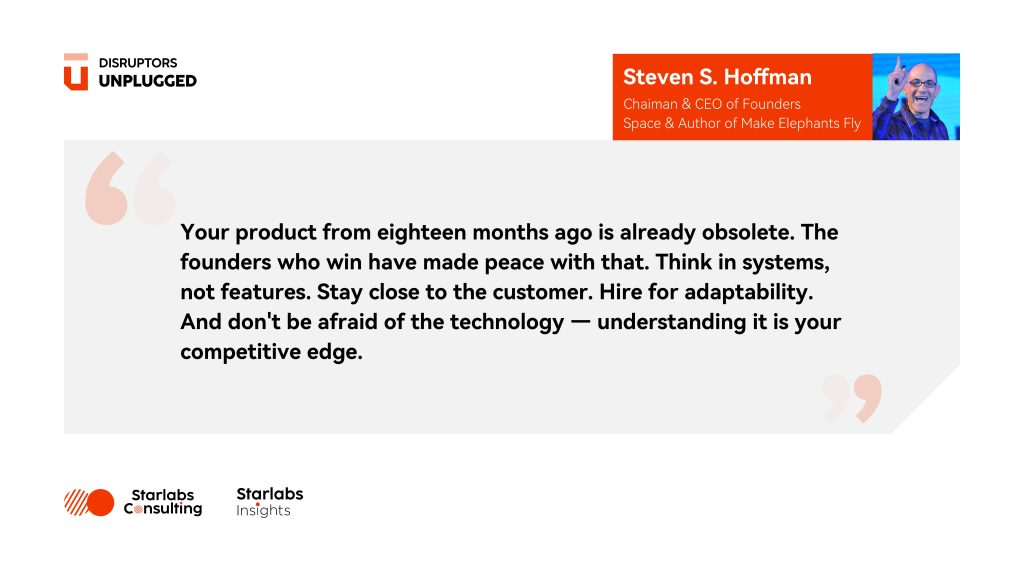
Steven S. Hoffman: Forget everything you think you know about defensibility. In this environment, your product from eighteen months ago is already obsolete. The founders who win are the ones who have made peace with that.
First: think in systems, not features. The next unicorn will not be built around a clever prompt. It will be built around a network of agents, data flywheels, and integrations that compound over time.
Second: stay close to the customer. AI makes it easy to build fast and drift into abstraction. The founders who win stay obsessively grounded in what real users actually need. Speed without direction is just chaos.
Third: hire for adaptability. The skills that matter today may not be the skills that matter in two years. Build a team that can learn, not just a team that can execute.
Fourth: do not be afraid of technology. Too many founders treat AI as a black box. Understand it well enough to know what it can and cannot do. That knowledge is your competitive edge.
Jenny Yang: Last question — Web3 and AI. Promising combination, or overhyped?
Steven S. Hoffman: I’ll be direct. Web3 has real value, but primarily for people already inside the crypto ecosystem. Decentralized finance, tokenized assets, cross-border settlement without intermediaries are meaningful applications for that audience. But that audience is still a small slice of the global economy.
When it comes to the average enterprise customer, small business owner, or user, it’s another story entirely. I don’t think Web3 is going to move the needle for the vast majority of the market. I’ve never been a fan, and I haven’t seen anything to change my mind in the past several years.
Most consumers and businesses do not need blockchain to accomplish their goals. They need reliable products, good user experiences, and fair prices. Web3 adds friction. It adds complexity. It adds regulatory risk. For the average customer and user, it adds nothing they were asking for.
AI, on the other hand, is a genuine general-purpose infrastructure. It touches every industry because every industry has problems that benefit from pattern recognition, automation, and intelligent decision-making. That is a fundamentally different value proposition.
Combining Web3 and AI does not multiply the value of either. It multiplies the complexity. For most founders, that is a trap, not an opportunity.
Steven S. Hoffman is the Chairman and CEO of Founders Space and the author of “Make Elephants Fly”, “Surviving a Startup”, and “The Five Forces of Innovation”. He advises governments, global enterprises, and accelerators worldwide.
About “Disruptors Unplugged”
“Disruptors Unplugged” is a Starlabs Consulting Original series that explores disruptive technology through insightful interviews with influential leaders in Web 3.0 and AI. This series features discussions with CEOs, founders, and co-founders who are central to the industry’s evolution, offering a deep dive into its significant impacts, current trends, and future directions. Aimed at a global audience of tech professionals, entrepreneurs, and enthusiasts, “Disruptors Unplugged” aims to enrich understanding, spark innovation, and drive the global discourse on technological progress, positioning itself as a leading platform for discovering the visionary insights and untold stories that are shaping the future of technology.
About Starlabs Consulting
Starlabs Consulting is a global leader in strategic and marketing consulting for the Web3 industry. Founded in 2018, we specialize in delivering end-to-end solutions across strategic planning, financial advisory, PR and marketing, risk forecasting and management, regulatory and legal compliance, crisis management, and innovation research.
We are committed to helping visionary companies navigate complexity in their growth, marketing, and operations — empowering them to thrive in competitive markets. With deep Web3 expertise and an extensive global network, Starlabs Consulting is the trusted partner of choice for many of the world’s leading crypto exchanges. Our professional team is known for its strategic insight, execution excellence, and unwavering client commitment, earning us a strong reputation across the industry.
Website: https://www.starlabsconsulting.com/