
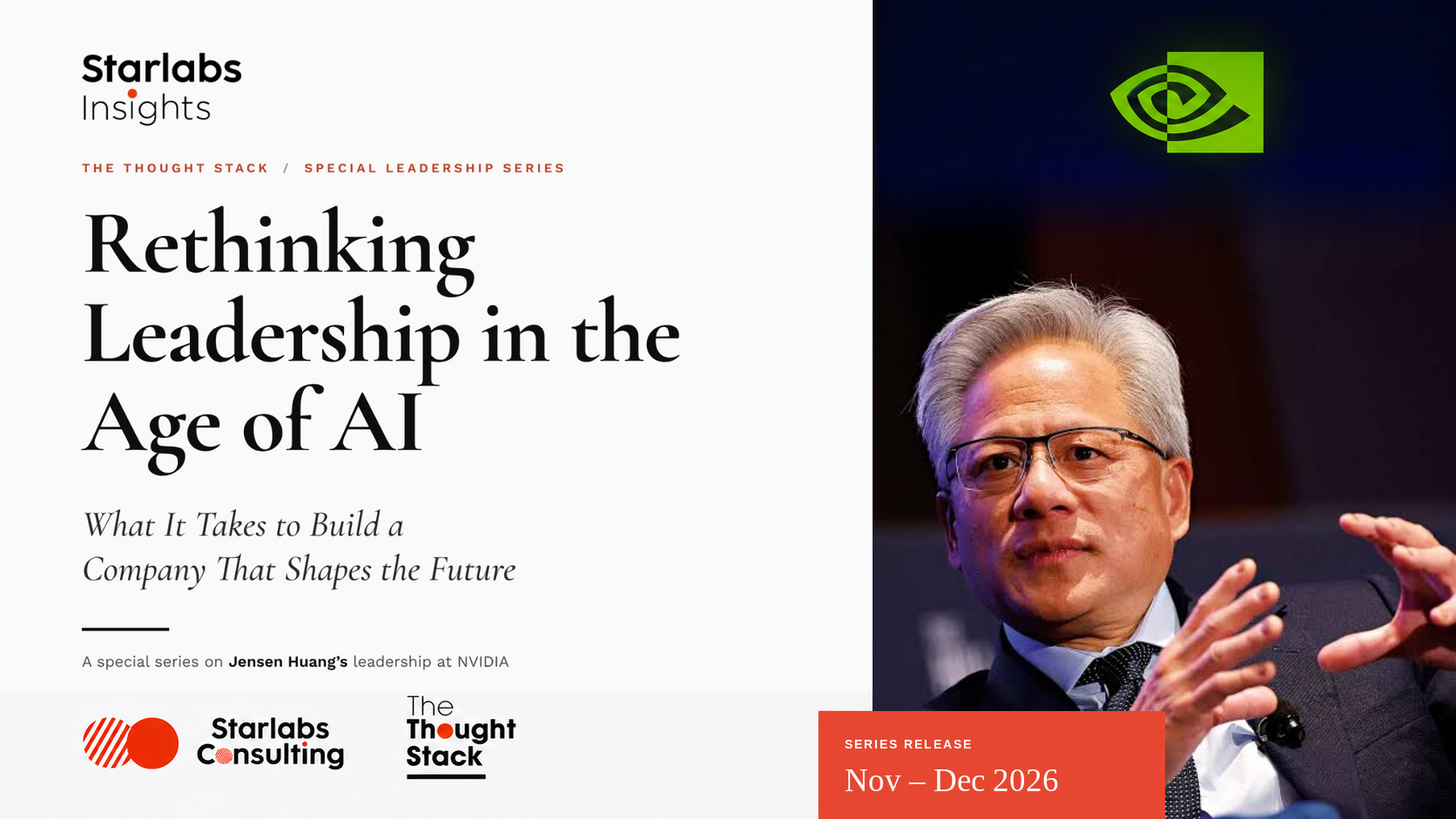
Rethinking Leadership in the Age of AI: What It Takes to Build a Company That Shapes the Future
The Thought Stack | Special Leadership Series
An exploration of the strategic thinking, organizational principles, and leadership capabilities required to build enduring companies in an era of technological transformation.
What does it take to build a company that can shape the future, rather than simply adapt to it?
As artificial intelligence reshapes industries, business models, and competitive landscapes, this question is becoming increasingly important for founders, CEOs, and business leaders everywhere.
The challenge, however, goes far beyond adopting new technologies. It calls for a fundamental rethink of how companies anticipate change, allocate resources, organize people, build competitive advantages, and lead through uncertainty.
Technology may create new opportunities, but it is leadership that determines how organizations recognize, pursue, and turn those opportunities into lasting value.
The Questions Every Business Leader Should Be Asking
For today’s business leaders, the AI era brings a set of interconnected strategic questions:
- How do you invest in a future that the market hasn’t validated yet?
When should a company commit resources to a long-term opportunity, especially when the commercial returns remain uncertain? - How do you redesign your organization to move at the speed of technological change?
Are traditional management structures, decision-making processes, and talent models still fit for an AI-driven business environment? - How do you build an ecosystem that makes your company indispensable?
In a world where products and technologies can be rapidly replicated, where does sustainable competitive advantage really come from? - How do you get people to believe in a future that doesn’t exist yet?
How can leaders translate a long-term vision into a shared sense of direction that inspires employees, customers, investors, and partners? - How do you build an organization that can outgrow its founder?
What does it take to move beyond founder-driven execution and create an institution capable of enduring and evolving over time?
These are not isolated management questions. Together, they point to a bigger challenge: how to build organizations that can continuously anticipate, navigate, and shape change.
Why Jensen Huang?
Few business leaders offer a more compelling case study for exploring these questions than Jensen Huang.
Over more than three decades, Huang has led NVIDIA through multiple technological transitions — from its early focus on graphics processing to accelerated computing and its central role in the development of modern AI infrastructure.
NVIDIA’s evolution is not simply a story of technological innovation or market success. It also offers a valuable opportunity to examine the strategic decisions, organizational choices, and leadership principles that helped a company position itself at the center of an emerging technological era.
Consider the long-term commitment to CUDA, the expansion from GPUs into a broader computing ecosystem, the company’s approach to organizational communication, and Huang’s ability to articulate a vision that extends beyond the immediate product cycle.
Behind these developments are questions that matter to companies far beyond the semiconductor industry:
How do leaders recognize opportunities before they become obvious? How do they build capabilities before the market demands them? And how do they align an entire organization around a future that is still taking shape?
The purpose of this series is not to celebrate an individual or present NVIDIA as a blueprint that every company should replicate. No two businesses operate under the same conditions, and leadership approaches cannot be separated from their organizational and market contexts.
Instead, we aim to look beyond the headlines and examine the thinking behind the decisions — identifying what other founders and business leaders can question, learn from, and potentially apply in their own organizations.
Five Dimensions of Leadership in the Age of AI
Through this special edition of The Thought Stack, we will explore five dimensions of Jensen Huang’s leadership:
01. Strategic Foresight — Building the Future Before the Market Is Ready
How do exceptional leaders anticipate structural shifts and make long-term bets before the market fully recognizes their potential?
02. Organizational Architecture — Scaling Without Slowing Down
What can NVIDIA’s organizational model reveal about information flow, decision-making, accountability, and the design of high-performance organizations?
03. Ecosystem Thinking — Turning Product Advantage into Industry Advantage
How did NVIDIA move beyond being a chipmaker to become an essential part of the broader AI computing ecosystem?
04. Narrative Leadership — The CEO as a Shaper of the Future
How do leaders communicate a vision, build conviction, and influence how an entire industry thinks about what comes next?
05. Institutional Leadership — Building Beyond the Founder
What does it take to create an organization that can evolve beyond the capabilities, decisions, and presence of its founder?
Each article will examine real business decisions and organizational developments, connect them to broader management challenges, and draw out practical insights for today’s business leaders.
Beyond One Leader, Toward Better Questions
At The Thought Stack, we believe that studying leadership should go beyond examining successful individuals or collecting lessons from their achievements.
The more important task is to understand the thinking behind their decisions — and explore how those ways of thinking can translate into better strategies, stronger organizations, and more enduring business capabilities.
Jensen Huang and NVIDIA provide one lens through which to examine this challenge. The questions, however, belong to every leader navigating technological transformation today.
Because in an era when technology is advancing faster than ever, the defining advantage may not simply be how quickly a company adopts what is new.
It may be whether its leaders can see what comes next, build what is needed before it becomes obvious, and create an organization capable of shaping the future.
About The Thought Stack
The Thought Stack is Starlabs Consulting’s editorial series dedicated to leadership research and strategic insights in the realm of disruptive global technologies. Through in-depth analysis of business leaders, companies, and emerging industry developments, the series explores forward-looking and actionable leadership frameworks to help organizations navigate transformation, pursue sustainable growth, and create long-term value.